
Your outbound system doesn’t know what went wrong
By Marco Serafini · · System Teardown
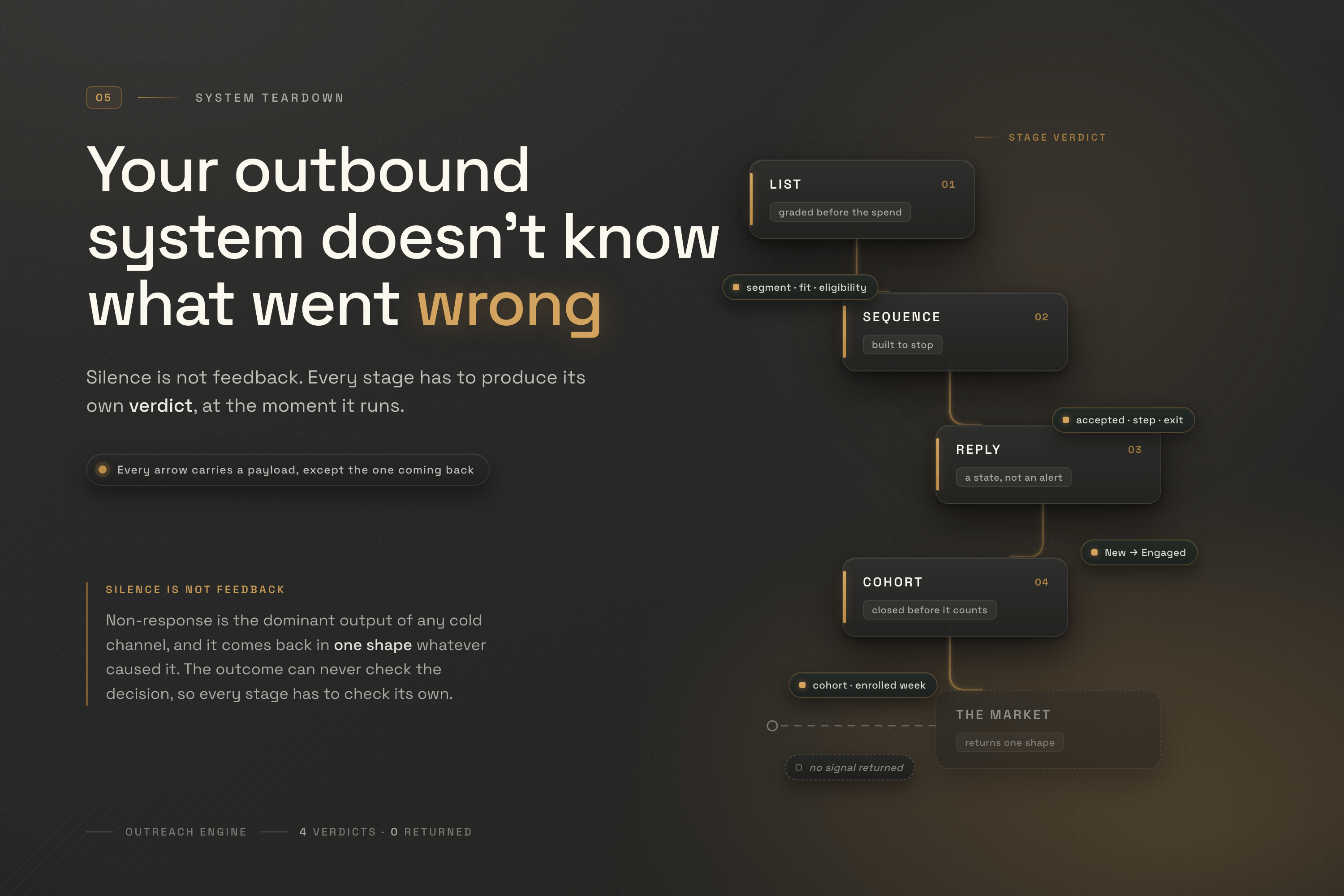
Change the copy and the reply rate moves. Change the list and it moves. Change nothing at all and it still moves.
A B2B outbound system is the only machine in your revenue operation that never reports on its own work. Almost everything it produces is silence, and silence arrives in one shape no matter what caused it: wrong company, wrong person, wrong message, wrong week, right everything and a bad Tuesday. The outcome cannot tell you which one you got. So the team tunes the variable it can watch move, which is the words, and carries nothing forward into the next campaign.
This is a teardown of that, and it is not a guide to writing better cold messages. The argument is narrower and, I think, more useful: a system that receives no usable feedback has to be built differently from one that does. Most outbound is built as though the market were going to answer.
Ours runs across Cargo for the list, Aimfox as the LinkedIn sequencer, Attio as the pipeline of record and n8n on the webhooks between them. None of the argument below depends on those four choices. The ordering is the part that transfers.
The copy is the only thing you can watch move
Replies drop. Someone pulls up the numbers. Two proposals arrive within the hour, and they are always the same two. Send more. Or rewrite the sequence.
Both are guesses dressed as decisions, and everybody in the room knows it, which is why the meeting is uncomfortable. Nobody can point at the thing that broke, because nothing broke in a way the system recorded. The messages went out. Some people did not answer. That is the entire evidence base.
The rewrite usually wins, and it wins for a structural reason rather than a psychological one. The sequence is the only artifact that survives between campaigns. It is written down, it has versions, you can read it on a screen and argue about a line in it. Every other decision the campaign made, who belonged on the list and why, which market was in scope, what made this person worth a message at all, was made once, inside a filter or inside somebody’s head, and then thrown away with the spreadsheet.
So the copy is not merely the wrong lever. It is the only lever the system left you.
Silence is not feedback
Every other system you run is corrected by reality, and you get that correction for free.
A deal closes or it doesn’t. A project ships late and the client says so. An invoice is paid or it sits there. In each case the outcome is observable, it is attributable, and it arrives attached to the decision that caused it. That is what lets a revenue system improve without anyone designing the improvement: reality keeps grading the work.
Cold outbound is the exception. The dominant output of any cold channel is non-response. Non-response is not a “no”, because a no carries information. It is the absence of a signal, and it is produced identically by every possible cause. You cannot tell a bad list from a bad message from a good message that landed the week someone’s biggest customer churned. You get one shape back, and it is the same shape every time.
That is the whole constraint, and almost every recognizable outbound failure is what happens when a team builds as though it weren’t there.
Two things follow.
The first is that volume does not fix it. More sends produce more silence, and more silence is not more information. This is the part that gets argued with most, usually by someone who has watched a bigger campaign produce more meetings. It does, and it still doesn’t tell you why. You can absolutely brute-force your way to a result you cannot reproduce.
The second is the design consequence. If the outcome can never check the decision, then the decision has to be checkable at the moment it is made. Each stage has to produce its own answer, and write it somewhere the next campaign can read, because nothing downstream is ever going to confirm or contradict it.
A stage verdict is the answer a stage writes down at the moment it runs: what it concluded, on what evidence, stored on the record rather than inside the campaign. It exists because a cold channel returns nothing capable of correcting a decision after the fact, so each decision has to stand on its own terms, before the send.
This is a cousin of a rule we apply everywhere else, that a workflow finishing without an error is not the same as the work being done, and it is worth naming the difference. There, the outcome exists and nobody looks at it. Here the outcome is unobservable in principle, which means the check cannot be moved later. It has to move earlier.
The first thing starvation does is make you accept counterfeit signal
Before the list, before the sequence, there is a temptation worth naming, because it is what a signal-starved system reaches for first.
If the channel won’t give you evidence, you will go and find some. Opens. Clicks. Profile views. Engagement on your content. Anything with a number attached, which then gets called a warm list and sent to.
We built the engagement version of this, so I can be specific about what it is worth. Post consistently for a year and a couple of thousand people will react to something of yours. Three in four do it once and never return. Fewer than one in ten ever write a word. Treat that population as interest and you have measured a feed.
What we score instead is what the engagement cost the person who produced it. A reaction is one tap, from a phone, in a queue, and is worth one point. A comment is a sentence in public, under a real name, where colleagues can see it, and is worth three. Warm starts at eight and Hot at fifteen. The four numbers live in a one-row table rather than in code, so retuning the whole classification is a row edit and the next morning’s run reclassifies everybody.
At that weighting a couple of thousand people come back as a few dozen. On my own account, which is considerably smaller, just under two hundred becomes seven.
The rule generalizes past engagement, and it is the only defense I know against counterfeit signal: weight a signal by what it cost the person who sent it. An open costs nothing and is often a machine. A reply costs a decision. Anything free is telling you about reach, and you are allowed to look at it, as long as nobody is allowed to send to it.
The list has to answer its own questions before it spends
The list is where the constraint bites hardest, because it is the stage furthest from any outcome and therefore the one most likely to be re-decided from scratch every quarter. Most of what an Outreach Engine build actually consists of is making this stage answer for itself.
I took the list apart stage by stage in a newsletter earlier this month, and I am not going to repeat that walkthrough here. What matters for this argument is the property those stages share rather than the stages themselves.
Every one of them produces a verdict that has to survive the campaign that paid for it.
Take the most expensive example. On the lists we pull, the industry label attached to a company is wrong about 38% of the time. Not slightly off, a different business. Which means the label narrows the haystack and decides nothing, and what actually decides is what the company sells, and that can only be read after the company has been enriched. The decision sits after the spend, not before it.
So where you put the answer determines whether the money comes back. Written into the campaign, every off-segment row is burned, and the same company gets enriched again next quarter by someone who has no idea it was already looked at. Written onto the record, it is a fact the business owns: this company sells that, we checked, here is when. The company that turns out to belong to a different campaign keeps its answer and waits for that campaign.
The same shape holds for the rest of it. Whether a market is open to a given channel is a property of the market, decided once and read for every row that comes out of it. Most teams invert that and decide per row, at send time, from memory, which turns one decision into a thousand and makes the answer depend on who is sending and how late in the day it is. And when a buyer has written something on their own profile about not wanting to be pitched, that is an instruction, and it has to land as a permanent state rather than a skip on this campaign, because a skip means the next campaign asks the same question, finds no answer, and messages them anyway.
None of that is bookkeeping. It is the only way a list gets cheaper instead of more expensive, and the only way the second campaign is smarter than the first.
When the channel finally does answer, most systems drop it
Halting the sends on a reply is a setting. Every sequencer ships it, nobody had to design it, and it is where most teams’ thinking about replies ends.
The minute after is where the single most expensive thing the system produces gets handled. A reply costs the list build, the enrichment, the qualification, and five messages over three or four weeks. It is also, for the reasons above, the only unambiguous signal the entire channel is capable of returning.
Then it lands in an inbox or a chat thread, which is not where any of the work is tracked. The CRM still shows the person sitting exactly where they were. No task exists. Whoever opens it has to scroll back through five messages to reconstruct what was already said to this person and why.
So it sits, and not because anyone decided to leave it there. An alert is a request, and requests get triaged against everything else asking that morning. A record that has moved is a fact, and facts do not queue.
This is the same obligation every stage of a lifecycle owes the next one, which I have written about for inbound handoffs. Outbound just has less margin for getting it wrong, because it produces one of these a week rather than one an hour.
Ours writes the reply onto the record before it tells a person. Aimfox fires a webhook on the first reply, n8n catches it, and the entry moves from New to Engaged in Attio on its own, once. Nobody has to remember, which is the entire point, because the alternative is a system whose one real output depends on somebody being at their desk.
What makes that stage change worth anything is everything the record was already carrying when the reply landed: which segment this company is in, how it graded, which seat this person holds, and the note explaining why they were worth writing to in the first place. Those were the verdicts from the top of this post, written down weeks earlier by the stages that produced them. The reply does not have to be researched. It has to be answered.
What comes after that stays a human call: meeting booked, qualified, not now, never. The system’s job was to make sure the call gets made at all.
I would put this above the copy on any list of things to fix, and it is almost never on one.
A rate you can act on needs a population that has stopped moving
Your reply rate falls when you scale sends because the denominator is full of people who have not finished the sequence yet, not because the copy got worse.
Here is the mechanism. The dashboard reports a date range: replies this month over sends this month. It looks obviously correct, which is exactly why nobody checks it. But a five-step sequence takes three or four weeks to run, so on the last day of the month everyone enrolled on the twenty-eighth is sitting in the denominator with four steps unsent, counted as a person who did not reply. They have not declined. They have not been asked yet.
That flaw does something worse than add noise. It moves the number in a predictable direction. Enroll more people and the share of unfinished sequences rises, so the rate falls. Stop enrolling and it climbs, because the only people left are the ones who had time to answer. The dashboard punishes you for scaling and pays you for stopping.
It also quietly breaks the one thing outbound teams trust. Split-test two sequences, read them the same afternoon, and the newer one looks worse, because more of it is unfinished. Every A/B result anyone has ever read off a live date range has this sitting inside it.
The correction is one decision, and it is the same decision as everywhere else in this post: measure a population that has stopped moving.
Group people by the week they were enrolled, never by the week a reply arrived. Keep a cohort open until every member has finished the sequence or exited it early. Only closed cohorts get a percentage, and an open one gets a raw count and nothing else. Keep early exits separate from non-replies, because someone who accepted a connection and went quiet is not the same as someone who never received the third message. Then read closed cohorts side by side, so a copy change is judged against a denominator that isn’t shifting underneath it.
What changes is not the number. It is that the number stops responding to how much you sent, which means that the next time it moves, something real happened.
What changes inside your own building
None of this makes cold outbound predictable. Nothing does. The market still answers with silence, and it will keep answering with silence no matter how well the system behind it is built. Everything that improves, improves on your side of the wall.
The second campaign costs less than the first, because most of what it needs to know is already sitting on records that were paid for once. Nobody re-argues eligibility in a meeting, because eligibility is a value someone can read before a send rather than a call somebody makes during one. A reply gets worked on the day it arrives, because arriving is what moves it, not somebody noticing. And when a rate finally moves, it moves for a reason, because the population underneath it stopped shifting.
There is also a quieter effect that took me a while to see. When every stage has to state its own verdict, the arguments change shape. The debate stops being “is outbound working” and becomes “is this specific answer still true”, which is a question a person can actually settle in an afternoon.
Every other system you run gets corrected by reality, for free, whether or not you designed for it. Outbound doesn’t, and volume cannot buy you the correction, because more sends return more silence and silence is not evidence of anything.
So the work moves. A B2B outbound system that holds up is one that answers its own questions on the way through and writes the answers down where the next campaign can read them, so that by the time the silence arrives there is nothing left for it to tell you.

Every other week I break down one operational system: what it does, where it leaks, and how to design the fix. No theory, no hype. Just the patterns that hold up in production.