
Build the Revenue OS before the stack
By Marco Serafini · · System Teardown
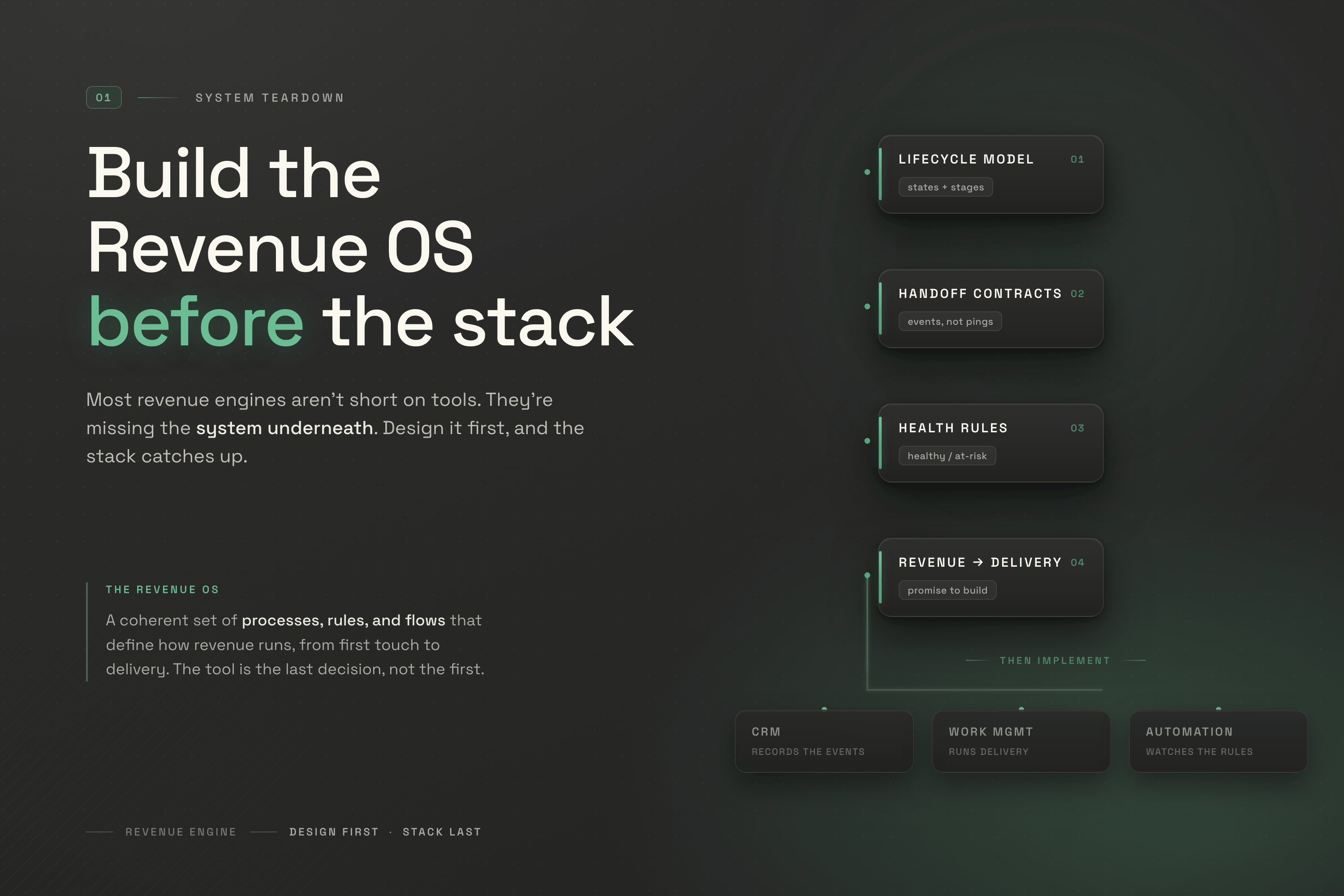
Most revenue teams aren’t starved for tools. They have a CRM, a marketing platform, an automation layer, and a few more apps besides. What they’re missing is the system underneath them. The fix runs the other way around: design revenue operations before choosing tools, build the Revenue OS first, and let the stack catch up.
It usually looks like this. A CRM with fields nobody trusts. Marketing capturing leads through three different flows with contradictory rules. Sales moving deals through stages that don’t match how delivery actually works. Customer teams inheriting accounts in separate tools, where the handoff depends on someone remembering to tag a colleague in Slack.
Then someone layers AI on top: enrichment scripts, inbox assistants, a couple of automations. More motion. Same confusion.
Six months after each “transformation” project, the same questions come back. Why do the forecasts still feel fictional. Why do handoffs still leak revenue. Why does every stack change feel painful and risky. The problem isn’t the tools. It’s the absence of a Revenue Operating System.
A Revenue OS is a coherent set of processes, rules, and flows that define how revenue actually runs, from first touch through delivery and expansion. This is how to design that system before you obsess over vendors. Tools appear in here only as examples of how to encode decisions you’ve already made. The real work sits upstream.
What a Revenue OS actually is
When teams say “we need a better system”, they usually mean “we need better tools”. They start shopping before they understand what they’re trying to run.
A Revenue OS is not a diagram of your tech stack. It’s not a collection of dashboards. It’s not a set of late-night automations duct-taping two SaaS tools together.
A Revenue OS is the operational chain connecting seven critical flows:
- Lead acquisition: how prospects enter and what data you capture.
- Enrichment and qualification: how you decide who deserves your team’s time.
- Routing and SLAs: who owns the lead, by when, given what you know. Drop the “by when” and a hot lead waits two days while a rep clears older work.
- Opportunity management: how deals progress and what “ready for next stage” actually means.
- Onboarding and delivery: how a won deal becomes live work, instead of a project that opens by reconstructing the contract from old email threads.
- Retention and expansion: how existing accounts are managed and signals become work.
- Feedback loops: how insights flow back into strategy.
For each flow, a Revenue OS defines three things:
- Events. What happened? “Lead submitted form.” “Deal moved to proposal.” “Onboarding blocked.”
- Owners. Who is responsible the moment the event fires?
- Behaviors. What should the system do automatically, especially when something is late, unclear, or missing?
Only after this clarity does it make sense to ask: which tools record these events, assign the work, and monitor compliance?
Without that foundation, you don’t have an operating system. You have a collection of surfaces.
The real mess: fragmented processes hiding behind dashboards
Zoom in on most revenue engines and the problem isn’t “no process”. It’s many local processes that don’t align.
On paper, the pipeline looks reasonable. In reality, marketing optimizes for lead volume with its own definition of a “good lead”. Sales builds shortcuts: extra stages, custom fields, personal views. Customer success inherits accounts with incomplete context and unclear expectations. Delivery receives projects that don’t map to how they actually run.
The result: leads arrive with inconsistent data and no clear next step. “Qualified” means something slightly different to every rep. Handoffs rely on manual notes and tribal knowledge.
Dashboards can’t fix this. They can only rearrange the view sitting on top of inconsistent rules. That’s why teams feel like they’re “improving visibility” without changing how revenue actually runs. The underlying system stays a patchwork.
The cost shows up in specific places. A deal parked in one rep’s custom stage that means nothing to anyone else, so nobody flags it. A “qualified” lead that means one thing to marketing and another to sales, so the forecast rests on a word with no shared definition. Onboarding reopening questions sales already answered, because the answers lived in a Slack thread instead of a field. None of it announces itself. It compounds one shortcut at a time, until what looks like a visibility problem turns out to be a rules problem. A Revenue OS starts by recognizing the patchwork and cleaning it up at the process and rules level, not the tool level.
Design your revenue operations before the stack
Before you touch tools, four pieces of design work sit at the heart of RevOps. Do them honestly, in this order, and the tool conversation becomes a much smaller problem.
1. Choose a lifecycle and pipeline model that fits your business
You don’t need abstract “best practice” funnels. You need a model that reflects how value actually moves in your specific context.
Answer these questions:
- Where does the journey truly start? Inbound form, outbound reply, partner introduction? Different sources behave differently.
- What are the irreversible moments? The shift from “could talk to” to “decided to pursue”. From “interested” to “committed to a project”.
- Where do you need explicit decisions? Disqualify now, move to nurture, ready for commercial proposal.
From those answers, define a small number of lifecycle states and pipeline stages that are easy to explain, map directly to concrete behaviors (what happens next), and stay consistent across teams, even when local nuances exist.
The goal isn’t capturing every variation. It’s creating a shared backbone you can build on.
2. Define handoffs as system events, not Slack conversations
Every time responsibility moves (marketing to sales, sales to onboarding, onboarding to delivery), you have a handoff.
In tool-first organizations, handoffs sound like “I’ll ping you when it’s ready”. In a Revenue OS, handoffs are system events with explicit contracts. For each one, four questions must be answered:
- What information must be present before the handoff can happen?
- Who becomes responsible the moment the event fires?
- What does “accepted” vs “rejected” handoff mean?
- What happens automatically if a handoff sits in limbo too long?
When you define handoffs this way, you can encode them in any stack. The important part is the contract, not the specific button that moves the item. This approach prevents the “lead black holes” where pipeline quietly leaks. Marketing sees follow-up velocity. Sales receives complete context. Customer success doesn’t inherit surprises. The stage-by-stage mechanics of these handoff contracts are in the lead lifecycle data contracts that run from first touch to handoff.
3. Define what “healthy” and “unhealthy” mean at each stage
Healthy revenue systems don’t just move things forward. They surface when something is stuck, unclear, or at risk.
For each lifecycle state and pipeline stage, ask: what does “good” look like? Time-in-stage, data completeness, owner assigned, next step defined. How long is too long? What SLA makes sense for this type of work? What are the common failure modes: no clear next step, missing context, conflicting information, awaiting customer action with no follow-up?
You’re not just tracking whether deals exist. You’re defining operating rules for how they should behave over time. An MQL sitting uncontacted for 48 hours triggers an alert to management. An opportunity in “proposal” stage for 21+ days without activity enters a “stuck deals” queue. A newly closed deal without required contract terms blocks the handoff to delivery.
Once you’ve made these decisions, you can attach alerts, queues, and reviews to them. But the rules come first. The shift is concrete: instead of a manager noticing a stalled deal in the weekly pipeline review, the system flags it the day it crosses the line, while there’s still time to act. At-risk revenue stops depending on someone happening to look.
4. Map how work moves from revenue to delivery
A Revenue OS doesn’t stop at “Closed Won”. It continues into how you fulfill what you sell. This is where operational debt accumulates the fastest: the gap between what sales promised and what delivery actually builds. The deal closes on a Friday with a verbal “we’ll handle the custom integration”, delivery starts Monday from a project brief that never mentions it, and three weeks in, a client is asking for something nobody scoped.
Answer these questions during design, not during the first “where’s the SOW?” scramble:
- What must exist before a deal can move into onboarding or project creation?
- How do you translate a commercial agreement into tasks, milestones, or SLAs?
- Where does ongoing ownership live as you transition from implementation to steady-state support?
Your goal is a traceable path from pipeline promises to delivery execution. Anyone should be able to answer, for any customer: what did we promise, what are we doing, who owns the next move?
When you can answer that confidently, your Revenue OS spans the full journey, not just the front of the funnel.
Only then: choose tools as implementations of your design
Once the Revenue OS is designed, tool conversations get easier. The question shifts from “what can this product do?” to:
- Can this CRM express the lifecycle states, events, and ownership logic we’ve defined?
- Can this work management system represent how we deliver, including queues, SLAs, and cross-team collaboration?
- Can our automation layer watch for the events and rule violations we care about without creating alert fatigue?
You might choose a CRM with flexible objects and workflows (in our case, that’s Attio). A work management platform that handles projects, operational queues, and recurring work (for us, ClickUp). An automation layer that connects the two (n8n). Notice the order: decide what the system should do, then choose tools that implement those decisions. We did exactly this for a B2B SaaS revenue system rebuilt on Attio after the design was settled on paper first.
This sequence prevents expensive shelfware and automated chaos. When teams select technology before defining processes, they create technical debt and fragile systems that break under scale. The order is the whole point: most of the work is process design, and the tool is the last decision, not the first. That balance ensures tools serve the Revenue OS instead of dictating it.
Where AI actually fits
Once the OS is clean, AI has somewhere to stand. Instead of scattering it “everywhere”, use it in two focused ways.
First, to enrich and structure data so your operating rules can be applied reliably. Firmographic enrichment. Contact scoring. Data normalization. Rules can only run if the data they depend on is present and consistent.
Second, as a watchtower that surfaces where rules are breaking, handoffs are failing, or customers are quietly drifting. Anomaly detection. Churn signals. Process compliance monitoring. Not prediction for its own sake. Early warning for the things the rules already care about.
AI is only as good as the data and processes it runs on. Bolt it onto an inconsistent “qualified” definition and a half-populated CRM, and it doesn’t fix the mess, it speeds it up: confidently wrong recommendations and brittle automations, produced faster. AI supports the Revenue OS. It doesn’t replace the work of designing it.
An end-to-end flow, without the tools
To make this concrete, a simplified journey from first touch to delivery, described entirely in Revenue OS language, without naming a single product.
A prospect fills out a form, replies to outbound email, or gets introduced by a partner. The Revenue OS defines the required fields, what happens when key information is missing, and how different source types are triaged.
Data is enriched (by humans, automation, or both) to reach a usable profile. The system applies basic qualification rules: firmographic fit, buying signals, timing. Leads not meeting the bar route into a clear path (nurture, partner, later review) instead of sitting in a generic pile.
Qualified leads trigger a routing rule: to an owner, a team, or a queue. Each route has an SLA. If the SLA is breached, the system treats it as an event: raising it in an “attention needed” queue rather than sending a notification everyone ignores.
As opportunities progress, each stage has clear entry criteria, clear exit criteria, a defined owner, and a defined next step. “Stuck” isn’t a feeling. It’s a state the system identifies based on rules you set.
When a deal is marked won, the handoff contract fires. Required data must be present: scope, constraints, stakeholders, timelines. The necessary artifacts are created: project, implementation plan, tasks. A new primary owner is assigned and accepts or rejects the handoff.
Delivery runs on its own workflows but stays connected to revenue. Health signals (usage, satisfaction, risk) become structured events that trigger actions in sales or success: check-ins, plan reviews, expansion conversations. Over time, a closed loop forms. What you sell, how you deliver, and how you grow are all visible inside the same operating system.
None of this depends on a specific vendor. It depends on the clarity of your Revenue OS design.
Common pitfalls when you skip the OS work
Teams that go straight to tools produce the same symptoms with remarkable consistency.
Local optimizations that clash. Marketing builds scoring logic. Sales redefines stages to match preferences. Success tracks “health” in spreadsheets. Delivery creates separate project templates. Individually each decision makes sense. Together they create a system where data can’t be stitched into a coherent story, nobody trusts the metrics, and changes in one area create unexpected side effects elsewhere.
Handoffs as favors instead of contracts. When handoffs depend on “can you please take a look at this?”, you get inconsistent handover quality, confusion over ownership, and a backlog of “almost ready” work that never quite makes it. A Revenue OS replaces favors with contracts. When X happens and Y is true, Z becomes responsible, and the system behaves in a specific, predictable way. If any element is missing, the system doesn’t quietly proceed. It flags the gap and prevents silent failure.
Dashboards that describe history but don’t change behavior. Reporting what happened is useful. But when you don’t define rules and events, dashboards sit on top of problems instead of changing them. A Revenue OS leans more on queues and system events than on static reports. The emphasis is on what needs attention now, where rules are being violated, and which parts of the journey constantly create rework. Without that focus, you end up with beautiful charts that don’t alter anyone’s day.
AI as a novelty layer. With no underlying system, AI experiments scatter. Enrichment here, summarization there, “smart” suggestions nobody fully trusts. In a Revenue OS, AI has a clear job: make the rules easier to apply and act as an early warning system. Subtle difference. It’s what separates noise from value.
What becomes possible
This is slow work, and it won’t fit into a one-hour workshop. But it’s the work that makes every other investment in revenue (people, tools, campaigns) compound instead of decay. It’s the core of what we design and build as a Revenue Engine.
If you design the Revenue OS first, and only then choose tools to implement it, several things become possible. You can change tools without rewriting how your company works. You can add AI and automation with clear purpose instead of as experiments. You can talk about “revenue performance” with a common language across marketing, sales, success, and delivery. You can grow without multiplying operational chaos.
The stack catches up to the system. Not the other way around.
Every other week I break down one operational system: what it does, where it leaks, and how to design the fix. No theory, no hype. Just the patterns that hold up in production.